
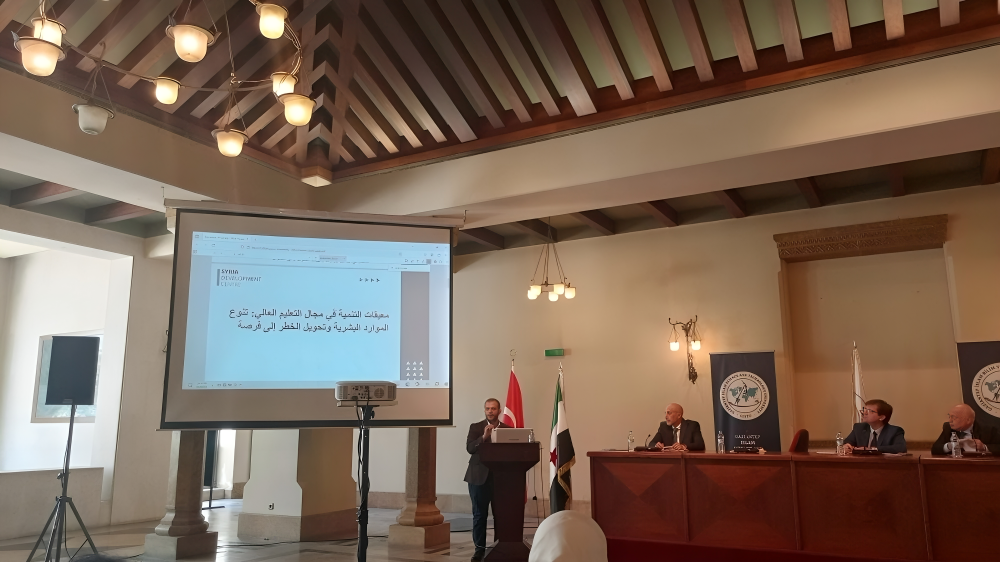
Barriers to Development and Institutional Capacity Building in Higher Education
Location: Syria, Damascus
Address: Damascus University
May, 2024
When Syrian experts abroad and local leaders join forces, solutions emerge. But why do so many still fail to take root?
Syria's reconstruction efforts have access to two powerful assets: the technical efficiency of its diaspora experts and the on-the-ground effectiveness of its local leaders. However, solutions may be effective but lack efficiency, or efficient but not feasible locally. Development efforts fail not due to lack of knowledge, but due to mismatched systems, fragmented mindsets and broken trust.
Effectiveness tends to emerge more strongly from within, as it is rooted in the lived realities of the community and its ability to implement solutions that are suitable and sustainable. In contrast, Efficiency emerges more strongly from the outside, where diaspora experts bring their technical experience through modern tools, evidence-based approaches, and globally tested models. The problem is that development efforts often fail not because of a lack of knowledge, but due to mismatched systems, fragmented mindsets, and broken trust, resulting in solutions that may be effective but lack efficiency, or vice versa.
The way forward is not simply about importing technical assistance, but about a more fundamental process of institutional design, trust-building, and enabling systems from the inside out. This means building institutions that are grounded in local realities rather than abstract international models, which requires a strategic partnership with local institutional leaders who bring community-rooted solutions. Successfully achieving this demands a new generation of institutional and social entrepreneurs, rooted in the social sciences, who can navigate these complex dynamics. Ultimately, especially in Syria’s case, true effectiveness emerges more strongly from within, as it is inextricably linked to the lived realities of the community.
At the Syria Development Centre, we have been observing this gap since 2022 and have been working to develop innovative approaches to bridge it. Our most prominent is the “hand-holding approach,” which is based on walking side-by-side with institutions and actors on the ground, rather than directing from above.
Below are some of the practical approaches we follow, derived from our on-the-ground experience:
Building trust and intensive mutual exposure
Enhancing institutional legitimacy internally and externally
Empowering local institutional leaders (a local strategic mindset)
Embedded envoys, not external consultants
Changing the stereotype
Building a new, unifying institutional narrative
Using a problem-based, reflective approach
Local adaptation of successful practices from other contexts
Genuine role-swapping (technical and institutional)
Moving from teaching to pedagogy (hand-holding)
Building joint research capacities (from design to implementation)
An adapted methodology for knowledge transfer and localisation (exit)
Centre team behind the work

Mhd Hassan Idelbi